Yan Zhang
Associate Professor
International Center for Quantum Materials, Peking University
Email: yzhang85@pku.edu.cn
Personal profile:
I received my B.Sc. and Ph.D. degrees at Fudan University in 2007 and 2012, respectively. From January to April 2010, I was invited as a youth visiting scholar at Hiroshima Synchrotron Radiation Center, Japan. During my Ph.D study, I have publlished more than 30 papers (9 as first or corresponding author) on the Nature Physics, Nature Materials, Physical Review Letters, etc. The overal citations are over 600. In Junly 2012, I attened the Nobel Laureate Meeting at Lindau, Germany as one of the representatives of Chinese doctoral students. From 2012 to 2014, I worked as a postdoctoral scholar at Stanford University. I joined the International Center for Quantum Mateirals (ICQM) in 2014 as an Assistant Professor and was promoted to Associate Professor in 2021.
Research Background:
In condensed matter physics, electrons play important roles. Under the interactions through charge, lattice, orbital, and spin, electrons evolve into many novel electronic states, such as high-temperature superconductivity, spin and charge density wave, magnetic and orbital ordering et al. The understanding of these electronic states not only deepens our understanding of the many-body physics and correlated electronic system, but also creates significant impact on the applications.
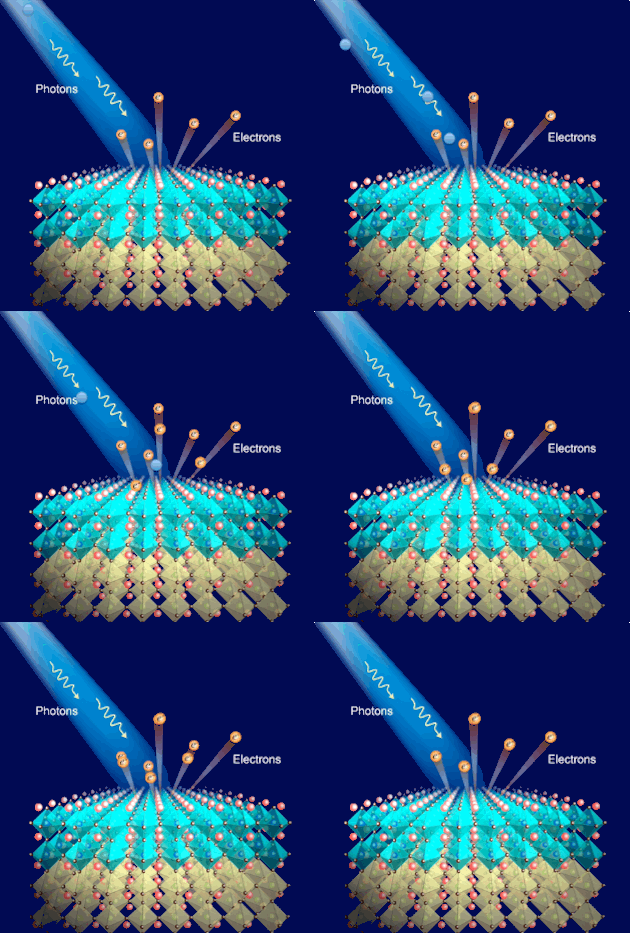
With angle-resolved photoemission spectroscopy (ARPES), we try to understand various novel electronic states in condensed matter physics. ARPES is one of the most powerful techniques to study the electronic state in materials. Based on the photoelectric effect, when a beam of monochromatized radiation is shined on a sample, electrons are emitted and escape to the vacuum (left panel). We then use a hemisphere energy analyzer to collect these photoelectrons. Through analysis, we could obtain various properties of the electrons in the solid, including Fermi surface, band dispersion, quasi-particle lifetime, electron-electron interaction, electron-boson interaction and so on (right panel). The ARPES technique is still in a fast development. The participation of the degrees of spin, time, and real space et al. in the future will make ARPES play more and more important roles in the research of condensed matter physics.
 |
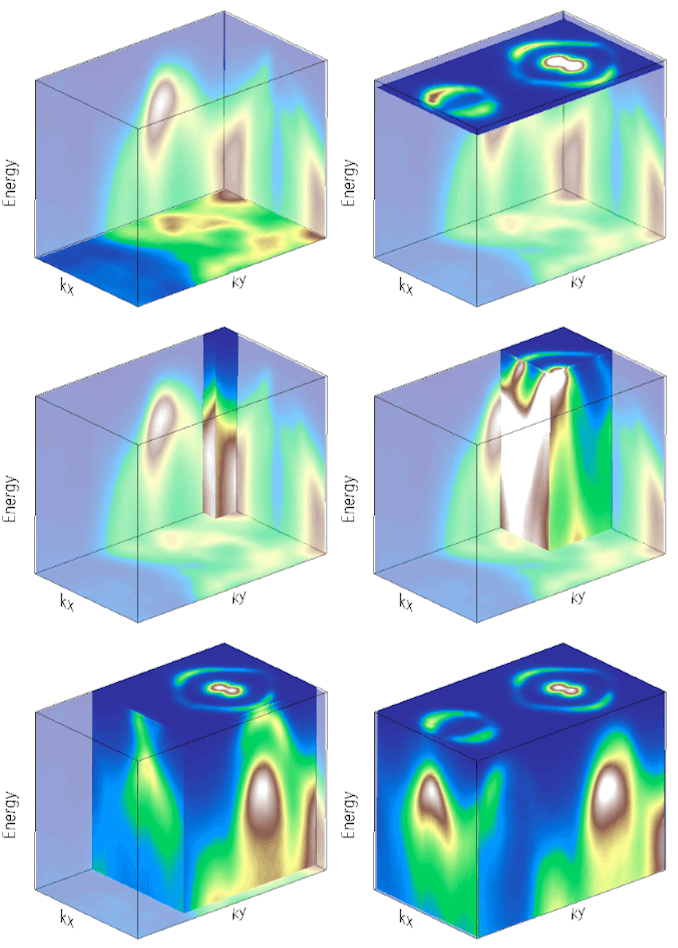 |
| Illustration of the principle of ARPES (left panel) | 3D plot of the ARPES data (right panel) |
Besides investigating the properties of electrons, we also try to design and tune the electronic states to make them practical, which is an important but also challenging issue. Typically, there are three ways to tune the electronic states. First, as to the bulk materials, we can change the temperature, pressure, carrier doping, magnetic field, and defects to tune their electronic states. Second, as to the thin films grown by Molecular Beam Epitaxy (MBE) or Pulsed Laser Deposition (PLD), we can modulate the growth conditions and substrates to tune the properties of the thin films and to obtain various non-equilibrium states. Finally, no matter for bulk materials or thin films, we can change their surface electronic states by gas absorption, ionic absorption, annealing, Electrochemical treatment and so on.
Research Interests:
The formation mechanism of novel electronic states and phase transitions:
l High-temperature superconductivity (Cuprates and Iron-based superconductors)
l Quantum phase transitions and critical phenomenon
l Complex strong-correlated materials (charge/spin density wave, spin/orbit ordering)
Low-dimension electronic states in interface and surface:
l Topological insulator
l Modulation of the surface electronic states
Experimental facilities:
l ARPES

l Single-crystal synthesis system

l MBE

Selected publications:
1. Y. J. Ren , J. Z. Chen, Z. M. Xin, P. H. Yuan, Y. Zhu, Y. Ou, L. L. Meng, and Y. Zhang*, “Large variation of interlayer coupling and electron hopping in 1T-TaSe2 resolved by angle-resolved photoemission spectroscopy”, Phys. Rev. B 112, 115123 (2025).
2. Yi Ou, Lei Chen, Ziming Xin, Yujing Ren, PenghaoYuan, Zhengguo Wang, Yu Zhu, Jingzhi Chen, and Yan Zhang*,“Incoherence-to-coherence crossover observed in charge-density-wave material 1T-TiSe2”, Nature Communications 11, 4215 (2020).
3. T. T. Han, L. Chen, C. Cai, Z. G. Wang, Y. D. Wang, Z. M. Xin, and Y. Zhang*,“Metal-Insulator Transition and Emergent Gapped Phase in the Surface-Doped 2D Semiconductor 2H-MoTe2”, Phys. Rev. Lett. 126, 106602 (2021).
4. T. T. Han, L. Chen, C. Cai, Z. G. Wang, Y. D. Wang, Z. M. Xin, and Y. Zhang*,“Metal-Insulator Transition and Emergent Gapped Phase in the Surface-Doped 2D Semiconductor 2H-MoTe2”, Phys. Rev. Lett. 126, 106602 (2021).
5. Y. D. Wang, W. L. Yao, Z. M. Xin, T. T. Han, Z. G. Wang, L. Chen, C. Cai, Yuan Li and Y. Zhang*,“Band insulator to Mott insulator transition in 1T-TaS2”, Nature Communications 11, 4215 (2020).
6. Y. Zhang, Z. R. Ye, Q. Q. Ge, F. Chen, Juan Jiang, M. Xu, B. P. Xie, and D. L. Feng*, “Nodal superconducting-gap structure in ferropnictide superconductor BaFe2(As0.7P0.3)2”, Nature Physics 8,371-375 (2012).
7. Y. Zhang, L. X. Yang, M. Xu , Z. R. Ye, F. Chen, C. He, H. C. Xu, J.Jiang, B. P. Xie, J. J. Ying, X. F. Wang, X. H. Chen, Jiangping Hu, M. Matsunami, S. Kimura, and D. L. Feng*, “Nodeless superconducting gap in AxFe2Se2 (A =K, Cs) revealed by angle-resolved photoemission spectroscopy”, Nature Materials 10, 273-277 (2011).
8. Y. Zhang, J. J. Lee, R. G. Moore, W. Li, M. Yi, M. Hashimoto, D. H. Lu, T. P. Devereaux, D.-H. Lee, and Z.-X. Shen*, “Superconducting Gap Anisotropy in Monolayer FeSe Thin Film”, Phys. Rev. Lett. 117, 117001 (2016).
9. Y. Zhang, L. X. Yang, F. Chen, B. Zhou, X. F. Wang, X. H. Chen, M. Arita, K. Shimada, H. Namatame, M. Taniguchi, J. P. Hu, B. P. Xie, and D. L. Feng*, “Out-of-Plane Momentum and Symmetry-Dependent Energy Gap of the Pnictide Ba0.6K0.4Fe2As2 Superconductor Revealed by Angle-Resolved Photoemission Spectroscopy”, Phys. Rev. Lett. 105, 117003 (2010).
10. Y. Zhang, J.Wei, H.W. Ou, J. F. Zhao, B. Zhou, F. Chen, M. Xu, C. He, G.Wu, H. Chen, M. Arita, K. Shimada, H. Namatame, M. Taniguchi, X. H. Chen, and D. L. Feng*, “Unusual Doping Dependence of the Electronic Structure and Coexistence of Spin-Density-Wave and Superconductor Phases in Single Crystalline Sr1-xKxFe2As2”,Phys. Rev. Lett. 102, 127003 (2009).
11. Y. Zhang, C. He, Z. R. Ye, J. Jiang, F. Chen, M. Xu, Q. Q. Ge, B. P. Xie, J. Wei, M. Aeschlimann, X. Y. Cui, M. Shi, J. P. Hu, and D. L. Feng*, “Symmetry breaking via orbital-dependent reconstruction of electronic structure in detwinned NaFeAs”, Phys. Rev. B 85, 085121 (2012). This paper has been selected as the “Editor’s suggestion”
12. Y. Zhang, B. Zhou, F. Chen, J. Wei, M. Xu, L. X. Yang, C. Fang, W. F. Tsai, G. H. Cao, Z. A.Xu, M. Arita, C.H. Hong, K. Shimada, H. Namatame, M. Taniguchi, J. P. Hu, and D. L. Feng*, “The orbital characters of bands in iron-based superconductor BaFe1.85Co0.15As2”, Phys. Rev. B 83, 054510 (2011). This paper has been selected as the “Editor’s suggestion”
Recruitments:
We plan to recruit 1 Ph.D students each year. We warmly welcome you aboard to delve into the enigmas of quantum materials and embark on a fascinating expedition through the microscopic world of electrons.