Zero-field superconducting diode effect with “normal-state memory” in kagome superconductor CsV3Sb5
Determining symmetry in the superconducting state and its relation to normal-state symmetry are important issues in condensed matter physics. In recent years, the kagome superconductor CsV3Sb5 has emerged as an ideal platform for this frontier research, owing to the complex quantum states arising from its unique lattice structure and electron correlation effects. However, a central scientific question behind these exotic quantum states remains unresolved: does spontaneous time-reversal symmetry breaking (TRSB) exist in this system, and if so, does it originate in the high-temperature charge density wave (CDW) state, or does it only emerge concurrently with the low-temperature superconducting state? Solving this core issue is crucial for a profound understanding of the microscopic mechanisms governing the complex quantum states in kagome superconducting systems.
Recently, Prof. Jian Wang’s group at International Center of Quantum Materials, School of Physics, Peking University, in collaboration with Prof. Ziqiang Wang at Boston College and Prof. Hechang Lei at Renmin University of China, has made a significant breakthrough addressing this core issue. By innovatively introducing a high-temperature magnetic field training protocol, the research team observed a zero-field superconducting diode effect (SDE) with “normal-state memory” in CsV3Sb5 devices at low temperatures. This discovery provides direct experimental evidence for spontaneous TRSB in the kagome superconducting system. Furthermore, it unambiguously reveals that this symmetry breaking is already established upon the formation of the high-temperature CDW state.
The research team fabricated high-quality CsV3Sb5 thin devices (with thicknesses ranging from 8.8 to 33 nanometers) using mechanical exfoliation and nanofabrication techniques, and subsequently conducted systematic electrical transport measurements. Current-voltage (I-V) characteristic measurements reveal that, under zero magnetic field, the positive and negative critical currents in the superconducting state are asymmetric (Figure 1), which is the hallmark of the SDE.
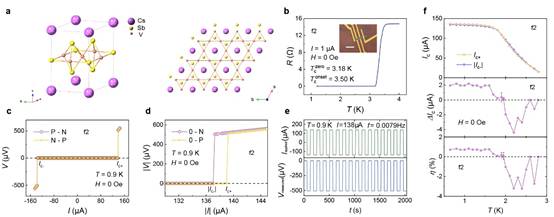
Fig. 1 Zero-field superconducting diode effect and rectification effect in CsV3Sb5 thin-flake devices
To verify the zero-field nature of the SDE, the research team employed rigorous techniques to calibrate the environmental magnetic field to within 0.01 Oe, including demagnetizing via an oscillating magnetic field at room temperature, warming the system’s superconducting magnet to room temperature to release any trapped magnetic flux, utilizing a high-precision Hall sensor to monitor the field, and actively applying a compensation field to cancel out the residual magnetic field. Under these stringent conditions, the research team further conducted in-situ device-flipping experiments. The polarity of the SDE remained invariant before and after flipping, which unambiguously ruled out the possibility of external remanence or the geomagnetic field induced SDE.
The emergence of the SDE requires the simultaneous breaking of both time-reversal and inversion symmetries. To explore the origin of TRSB in the superconducting state of the CsV3Sb5 devices, the research team innovatively introduced a high-temperature magnetic field training protocol: a magnetic field was applied to the device at 300 K, followed by field-cooling across the CDW transition temperature. Before entering the superconducting transition, the magnetic field was completely removed to zero (e.g., at 50 K or 5 K), and the device was subsequently cooled to the zero-resistance superconducting state under zero field. Statistical data revealed a strict one-to-one correspondence between the polarity of the low-temperature zero-field SDE and the direction of the high-temperature training magnetic field (Fig. 2). In a control experiment, if the magnetic field was removed at 150 K (above the CDW transition temperature), the SDE polarity was stochastic, independent of the high-temperature training field direction (Fig. 3).
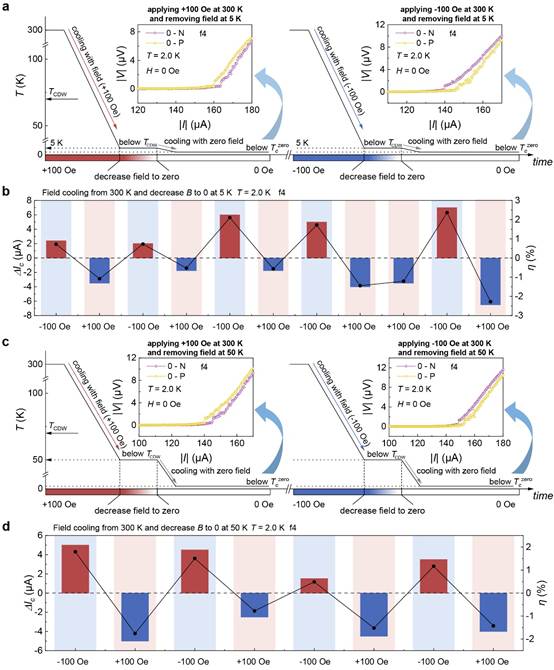
Fig. 2 After field-cooling from room temperature across the CDW transition and subsequently removing the field, the polarity of the low-temperature zero-field SDE shows a strict one-to-one correspondence with the direction of the normal-state training field.
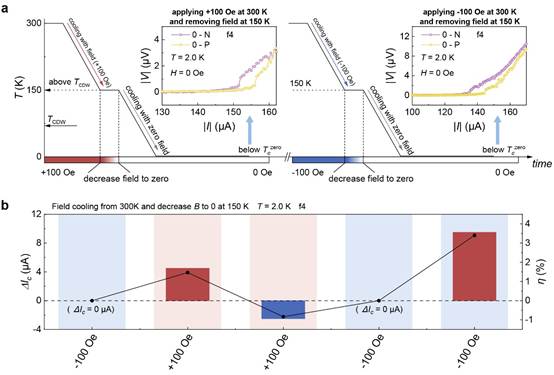
Fig. 3 Removing the field above the CDW transition results in a random SDE polarity at low temperatures, independent of the training field direction.
These results demonstrate that in CsV3Sb5, spontaneous TRSB is established within the normal state featuring CDW state well before the onset of the superconducting transition. This aligns with the theoretical picture where TRSB in kagome systems is driven by microscopic “loop currents”. The TRSB established in the normal state dictates the chiral characteristics of the superconducting state at low temperatures. Macroscopically, this process manifests as an intrinsic physical memory effect: the external magnetic field “writes” the chiral information into the high-temperature normal state, while the low-temperature zero-field SDE polarity “reads” this information. Furthermore, the zero-field SDE is also observed in the nanopatterned micro-bridge structures, indicating that the nanofabrication process does not disrupt the spontaneous TRSB in this kagome superconductor.
The zero-field SDE with “normal-state memory” in the kagome superconductor CsV3Sb5 provides direct evidence that TRSB originates in the high-temperature CDW state. This work, titled “Nonreciprocal superconducting critical currents with normal state field trainability in kagome superconductor CsV3Sb5,” was published online in Nature Communications on May 5, 2026. Dr. Jun Ge and Xiaoqi Liu from the International Center for Quantum Materials, School of Physics, Peking University, are the co-first authors, and Professor Jian Wang is the corresponding author.
Paper link: https://www.nature.com/articles/s41467-026-72799-6