Local Spectroscopy Reveals the Quantum Secret in Superconductor-Insulator Transitions at Atomic Scale
The superconducting state originates from the formation of long-range coherent Cooper pairs. When disorder is introduced into superconducting films at the two-dimensional (2D) limit, quantum fluctuations and localization effect are intertwined. During the disorder-induced quantum phase transition (QPT), do the Cooper pairs simply break, or do they remain paired and form an emergent state? This is a central scientific question in the field. Professor Jian Wang’s group at International Center for Quantum Materials, School of Physics, Peking university, together with collaborators, addressed this question in crystalline iron-based high-TC Fe(Te,Se) monolayers (around 0.59 nm thick) by in situ deposition of iron atom clusters to controllably introduce disorder. Utilizing Scanning Tunneling Microscopy and Scanning Tunneling Spectroscopy (STM/S), the researchers observed for the first time the local spectroscopic signatures of a disorder-induced superconductor-to-insulator transition (SIT) in a 2D unconventional high-Tc superconductor. Their findings reveal the localization of Cooper pairs as an origin of insulating states.
In previous studies, Jian Wang’s group discovered the quantum Griffiths singularity—a novel QPT characterized by a divergent dynamical exponent at the critical point—in three-monolayer thick Ga films (Science 350, 542 (2015)). They subsequently confirmed its universality across various 2D superconducting systems (Nat. Commun. 10, 3633 (2019); Phys. Rev. Lett. 127, 137001 (2021)) and 3D superconductors with strong fluctuations (Phys. Rev. Lett. 133, 226001 (2024)). These discoveries challenged the cognition that the dynamical critical exponent is a constant value in QPTs and Kosterlitz-Thouless transitions, revealing the decisive roles of disorder and dissipation in QPT and expanding the universality class of QPT.
Prior studies of superconducting QPT largely relied on macroscopic transport measurements, leaving the microscopic picture unclear. By depositing Fe clusters using ultrahigh vacuum molecular beam epitaxy, recently Jian Wang’s group has modulated the disorder strength in iron-based high-TC superconducting Fe(Te,Se) monolayers. Before the deposition of Fe atomic clusters (corresponding to low disorder), the tunneling spectra exhibit well-defined superconducting gaps with coherence peaks. At moderate disorder strength after Fe clusters deposition, the typical superconducting "U-shaped" gap evolves into a "V-shaped" gap (Fig. 1). The superconducting coherence peaks gradually weaken and disappear, indicating that the disorder enhances phase fluctuations and suppresses the long-range coherence of superconductivity.
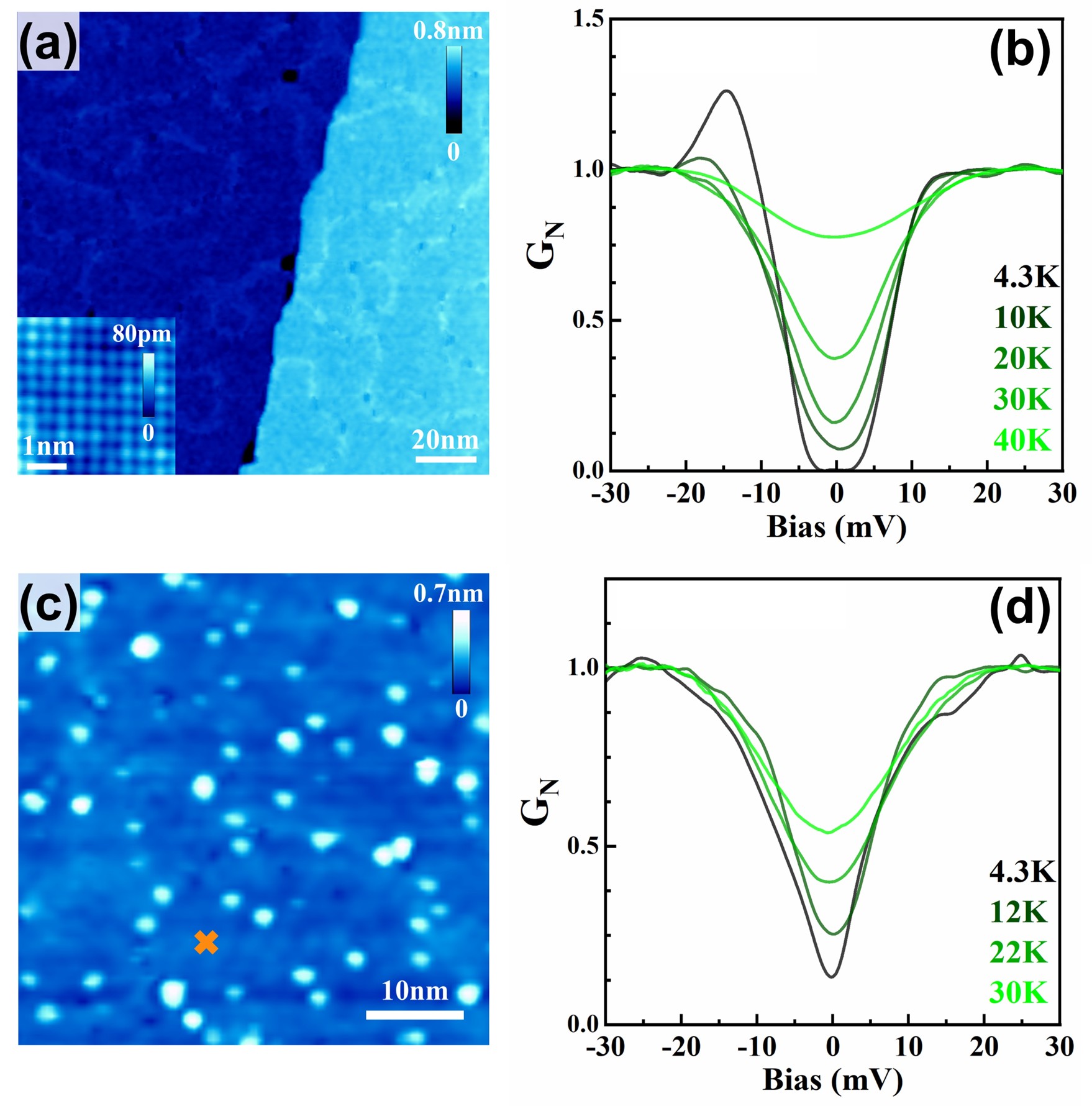
Figure 1. Local spectroscopy on a monolayer superconducting Fe(Te,Se) reveals an evolution from a U-shaped to a V-shaped gap, before and after Fe atomic cluster deposition.
The researchers further map the local density of states (LDOS) in real space for moderate disorder levels. Under negative bias, the LDOS shows spatially inhomogeneous localized states, following a log-normal distribution; under positive bias, the LDOS evolves into spatially uniform extended states, following a Gaussian distribution (Fig. 2). This transition suggests that the disorder not only suppresses long-range coherence of Cooper pairs but also simultaneously drives the system toward the mobility edge of Anderson localization.
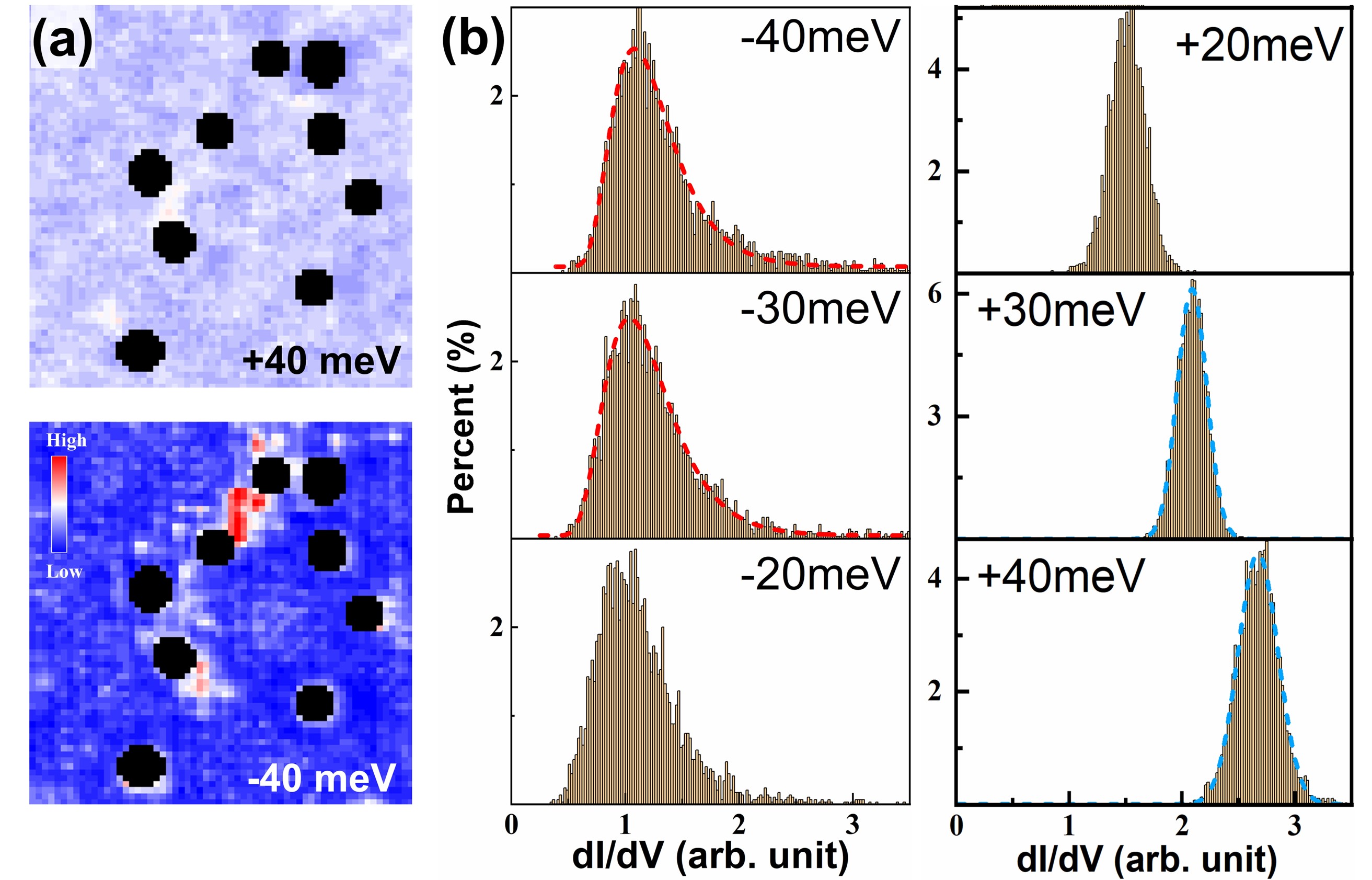
Figure 2. After depositing Fe clusters of moderate density, the real-space distribution of the electronic density of states exhibits a transition from localized to extended states under different bias voltages.
After the coverage of Fe clusters is further increased (corresponding to strong disorder), the researchers observed a large U-shaped gap (Fig. 3, right panel), exceeding the magnitude of the initial superconducting gap. Crucially, this gap lacks coherence peaks and the gap size increases with disorder strength. This unusual effect reflects the intricate interplay between superconductivity and localization. This finding is supported by theoretical models where the multifractal nature of electronic wavefunctions enhances local superconducting pairing, resulting in enlarged gaps due to localization. Macroscopic transport measurements showed the sample enters a global insulating state in the strong disorder regime, confirming the disorder-induced SIT.
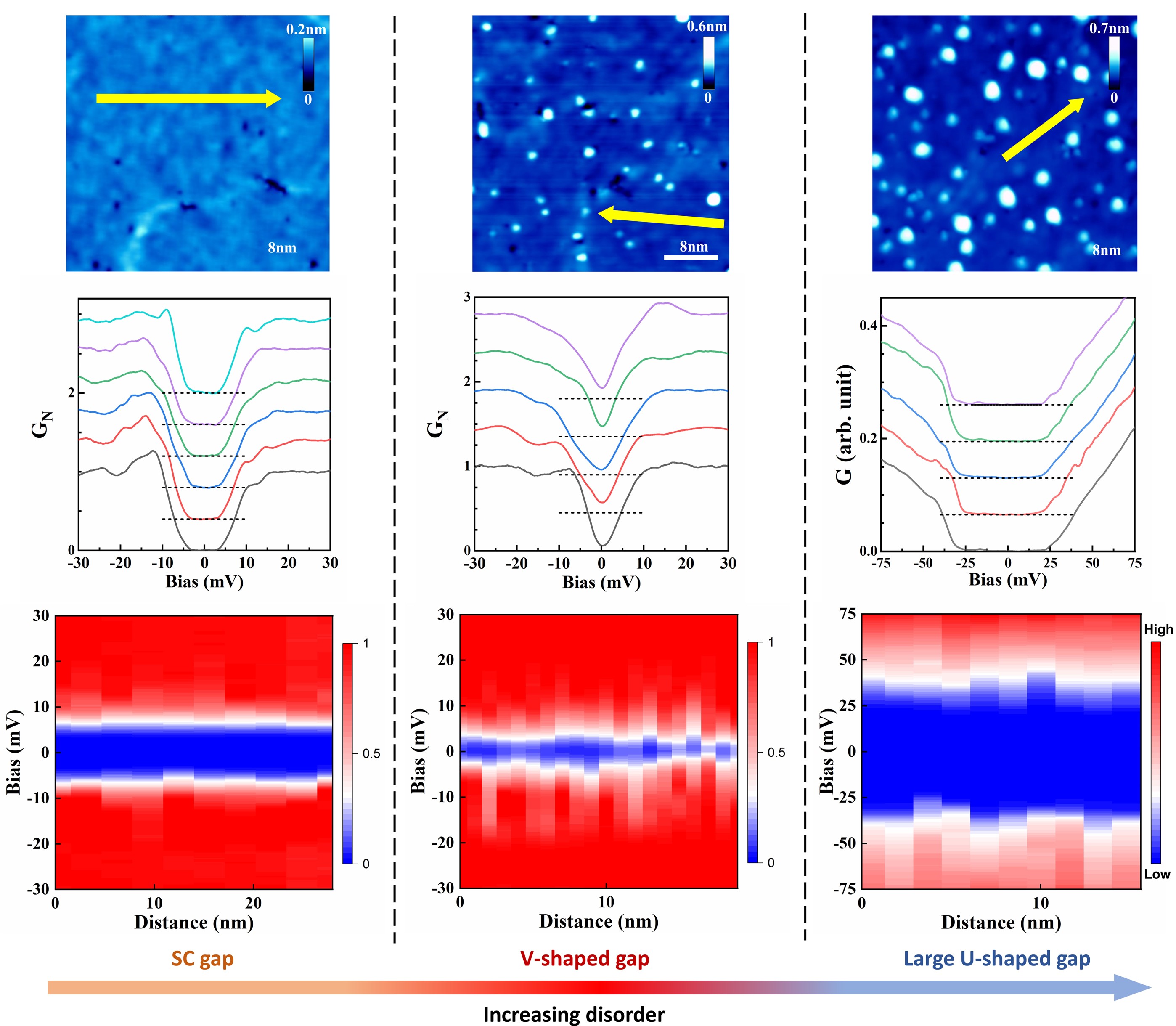
Figure 3. Evolution of the energy gap observed by local spectroscopy during the quantum phase transition from superconducting to insulating state in Fe(Te,Se) monolayer.
This study provides the first local spectroscopic evolution of the disorder-induced SIT in a 2D iron-based high-TC superconductor. The results deepen the understanding of QPTs in low-dimensional high-TC superconductors, especially the interplay between superconductivity and localization, and demonstrate the power of local spectroscopy in probing QPT and quantum ground states in unconventional superconductors.
This research, entitled “Spectroscopic evidence of disorder-induced quantum phase transitions in monolayer Fe(Te,Se) superconductor”, was published in Physical Review Letters on April 29, 2026. Guanyang He (Assistant researcher at ShanghaiTech university, former postdoc at Peking university) and Ziqiao Wang (Associate researcher at Guangdong-Hong Kong-Macao Greater Bay Area Quantum Science Center, former postdoc at Peking university) are the co-first authors. Prof. Jian Wang is the corresponding author. Other collaborators include Professor Nandini Trivedi at the Ohio State University, Associate Professor Yi Liu and Mr. Longxin Pan at Renmin University of China, and Associate Professor Fa Wang and Mr. Yuxuan Lei at Peking University.
Publication link:https://journals.aps.org/prl/abstract/10.1103/gkvs-4vsb